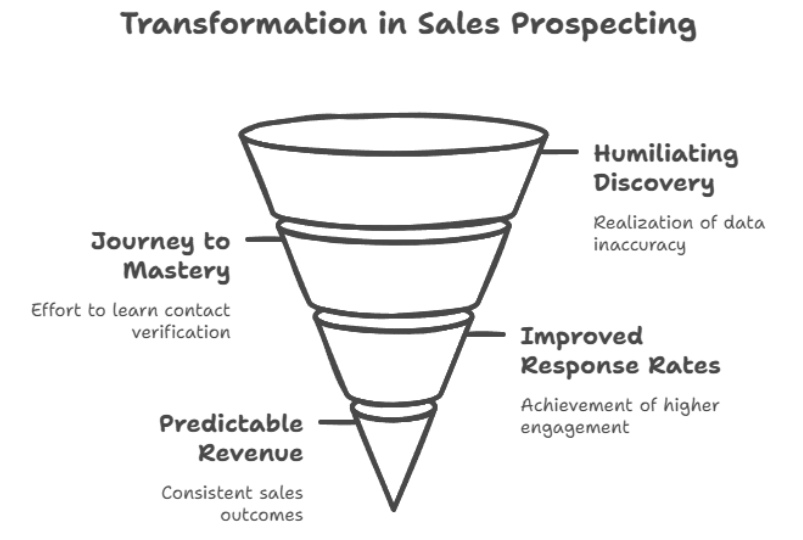

I’ll never forget the moment that changed everything. Three weeks into my sales career, armed with what I thought was a solid lead list, I confidently dialed what was supposed to be the VP of Sales at a Fortune 500 company. After three rings, a confused voice answered-not a VP, but an intern who informed me that the person I was calling for hadn’t worked there in over a year. That humiliating moment wasn’t just embarrassing-it revealed a fundamental truth about modern sales: unverified contact data is nothing more than expensive fiction.
This revelation sparked a multi-year journey to master the science of contact verification. What I discovered transformed my response rates from an embarrassing 2% to consistently exceeding 30%. More importantly, it fundamentally changed how I approach prospecting. In today’s data-drenched world, verified contact information isn’t just helpful-it’s the dividing line between wasted effort and predictable revenue. To achieve that go to Connexy for extra information!
The Hidden Costs of Dirty Data (Beyond the Obvious Problems)
We all know bad data wastes time. But the real impact goes much deeper than the occasional bounced email or wrong number. Let’s examine the silent killers lurking in your CRM:
The Productivity Paradox
Studies show sales reps spend just 36% of their time actually selling-the rest disappears into administrative tasks and dead-end prospecting. But here’s what the research doesn’t tell you: Each unverified contact creates a cascading time drain. Think about the domino effect:
- 5 minutes crafting a personalized email to the wrong person
- 10 minutes preparing for a call to a disconnected number
- 15 minutes researching a company where your champion just left What seems like small inefficiencies compound into massive productivity black holes.
The Credibility Tax
In an era where buyers research vendors before engaging, first impressions are everything. A study by MarketingSherpa found 82% of executives delete emails containing incorrect information about their role or company. Even worse? They remember the sender-but not in a good way. I learned this the hard way when a CEO publicly shamed our company on Twitter after receiving a poorly researched pitch.
The Algorithmic Penalty
Email providers now use engagement metrics (opens, clicks, replies) as spam filters. Each bounced email or ignored message trains AI to route your future emails-even valid ones-straight to spam. One client saw their deliverability drop from 95% to 62% in three months from bad data, essentially silencing their outreach.
Redefining “Verified” for the Modern Sales Era
Most sales leaders think verification means checking if an email exists. That’s like saying a car is “roadworthy” because it has wheels. True verification requires a multi-dimensional approach:
The Hierarchy of Contact Verification
- Existential Verification: Does this contact method (email/phone) technically work?
- Occupational Verification: Is this person still in this role at this company?
- Receptivity Verification: Is this their preferred channel for outreach?
- Temporal Verification: Is this a good time to reach them?
I developed this framework after discovering that 40% of “verified” emails in our CRM were technically valid but belonged to people who’d moved roles or companies-rendering them useless for targeted outreach.
The Dark Side of Automation
Sales tech vendors love promising “100% accurate data.” It’s nonsense. Even the best databases decay at 2.1% monthly. The solution? Pair automation with human validation. My rule: Always cross-reference automated verification with at least one human touchpoint (LinkedIn check, manual call, etc.). It’s more work, but it prevents those cringe-worthy wrong-person moments.
The Four-Phase Verification Framework That Works
After testing countless approaches, I distilled verification into a repeatable four-phase system that consistently delivers 85%+ accuracy:
Phase 1: Intentional Prospecting
Before verifying a single contact, get crystal clear on:
- Target company health signals (funding rounds, leadership changes)
- Department structures (who reports to whom)
- Current initiatives (from press releases or earnings calls)
Example: When targeting a SaaS company that just secured Series B funding, we focused on new VP hires-they’re most likely evaluating new tools.
Phase 2: Multi-Source Validation
Combine:
- Automated verification (ZoomInfo, NeverBounce)
- Social validation (LinkedIn, Twitter)
- Manual confirmation (receptionist calls, directory checks)
For crucial accounts, I add a fourth layer-analyzing their digital footprint for signs of active engagement (recent posts, comments, etc.).
Phase 3: Contextual Enrichment
Verification isn’t just about accuracy-it’s about relevance. We append:
- Tech stack data (what tools they use)
- Content engagement (what they’re reading)
- Peer connections (who we know in common)
This transforms cold outreach into warm introductions. One prospect responded immediately when I referenced their recent blog post about a challenge we specialize in solving.
Phase 4: Continuous Revalidation
Implement monthly “data health checks”:
- Automated alerts for job changes (Google Alerts, CrystalKnows)
- Quarterly manual reverification of top prospects
- Real-time updating when bouncebacks occur
This closed-loop system reduced our data decay rate from 3.2% to just 0.7% monthly.
The Personalization Paradox (And How Verified Data Solves It)
“Personalized” outreach has become meaningless-most “personalized” emails are just templated garbage with a first name. True personalization requires:
The 5 Levels of Sales Personalization
- Identifier Level: “Hi [Name]” (bare minimum)
- Role Level: Addressing their specific challenges
- Company Level: Referencing recent company events
- Industry Level: Connecting to sector trends
- Personal Level: Noticing individual achievements
Verified data makes this possible. Recently, I won a Fortune 500 deal by congratulating a CMO on their recent promotion-information I verified through three independent sources before mentioning it.
Tools vs. Strategy: Building Your Verification Stack
The tool landscape is overwhelming. Here’s how to think about it:
The Verification Stack Hierarchy
- Base Layer: Email/phone validators (NeverBounce, NumVerify)
- Insight Layer: Intent data tools (Bombora, 6sense)
- Context Layer: Relationship mapping (Affinity, People.ai)
- Automation Layer: CRM integrations (Salesforce Data.com)
Most companies buy tools backwards-starting with fancy AI predictors before nailing basic validation. Get the fundamentals right first.
The Hidden Gem: Internal Data
Your CRM contains gold-past interactions, email responses, meeting notes. We built a simple scoring system tagging contacts by:
- Response history
- Engagement patterns
- Relationship depth
This “internal verification” became our most reliable predictor of future engagement.
Measuring What Actually Matters
Vanity metrics deceive. Track these instead:
The Verification ROI Formula
(Revenue from Verified Leads – Verification Costs) / Verification Costs
One client calculated 12:1 ROI-every $1 spent on verification generated $12 in revenue.
The Hidden Metric: Time-to-Verification
How long from lead capture to full verification. We reduced ours from 72 hours to 4 hours-massively improving response rates.
The Future: Where Verification is Heading
Three emerging trends will redefine verification:
- Blockchain-Verified Profiles: Professionals managing their own verified identities
- Predictive Verification: AI forecasting which contacts will soon change roles
- Ethical Data Sourcing: Tighter regulations on how data is collected/shared
Verification as Competitive Advantage
In a world drowning in bad data, rigorous verification isn’t just operational hygiene-it’s a moat. The companies that will dominate their markets won’t just have more leads; they’ll have the right leads at exactly the right time.
The scary truth? Your competitors are probably reading this same article. The question isn’t whether you can afford to improve verification-it’s whether you can afford not to.